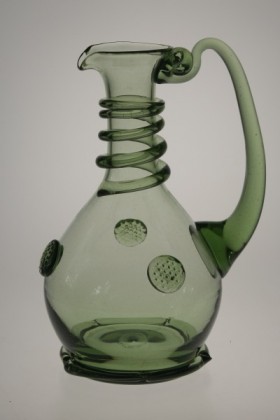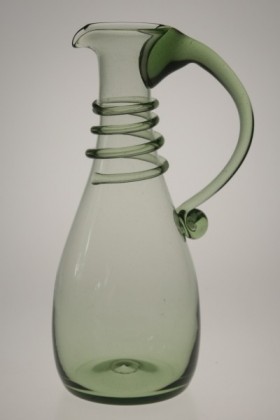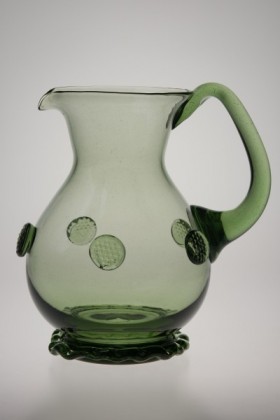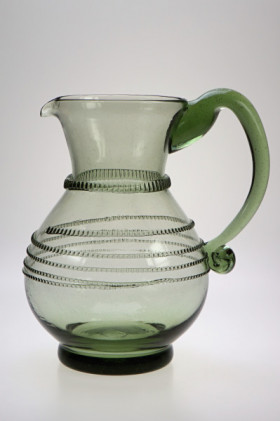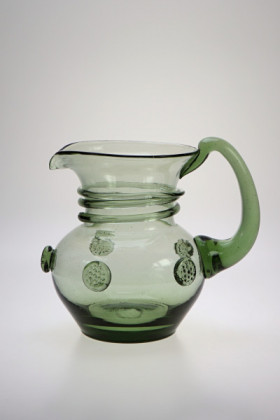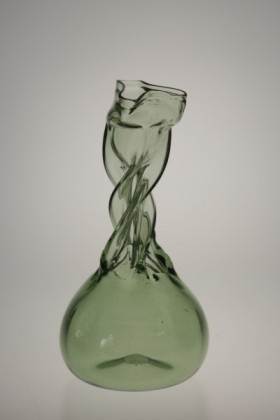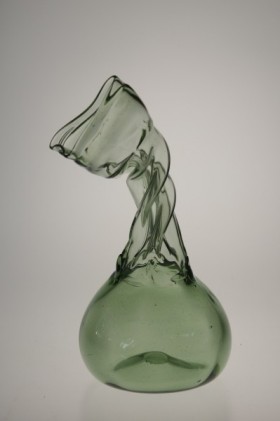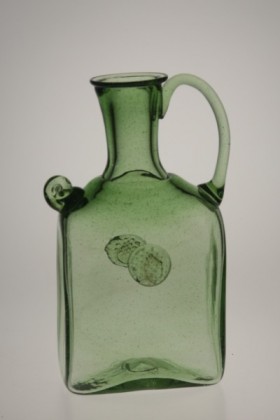


Carafe
Forest green glass carafes and pitchers were crafted throughout Europe in a wide variety of shapes and sizes, largely inspired by Italian designs. The earliest patterns can be traced back to the 13th century. The primary buyers of this glassware were castles, monasteries, and churches. In Bohemia, the first archaeological finds of this type of glass date back to approximately 1460.
Bottles and flasks were produced in various shapes and sizes, serving both for dining and as essential equipment in castle kitchens (for vinegar, oils, etc.), as well as by cellar masters for storing rare wines. One of the most widespread types in the Middle Ages was the Kuttrolf. Originally a decorative vessel from late antiquity, it appeared in many variants with one, two, or more intertwined necks (tubes). While in antiquity these vessels served as perfume containers, a function they retained in Southern Europe and France through the Renaissance. The Kuttrolf saw its greatest popularity in Germany, where it remained in use until the 18th century. Its presence is also clearly proven in Bohemia, where it was commonly used for wine and spirits well into the 17th century.